How HEBE Steel Maintains Product Quality and Consistency


Blog Article
Product consistency matters at every stage of steel buying and fabrication. When dimensions vary or material is mixed incorrectly, fabricators may spend more time measuring, correcting fits and adjusting jigs. Dealers can also face stock identification problems and customer complaints.
HEBE Steels supports quality through a defined manufacturing flow, in-house chemical and physical testing, dimensional checks, batch-wise inspection and controlled material handling. These systems are intended to help customers receive mild-steel sections that are uniform, clearly organized and suitable for the stated requirement.
What Product Consistency Means to Steel Buyers
Consistency means that products supplied against the same specification should have dependable dimensions, shape and material characteristics within the applicable requirements. For a fabricator, this can support repeatable cutting, fitting and welding. For a dealer, it can simplify stock management and improve confidence when serving regular customers.
Quality cannot be judged by appearance alone. Product identity, dimensions, material properties and the requirements of the intended application all matter. That is why HEBE combines production controls with inspection and testing.
A Structured Rolling Process
HEBE manufactures light structural long products through a re-rolling process. The stated production flow begins with billets, followed by furnace heating, rolling through multiple passes, cooling, cutting and batch-wise stacking.
Each stage affects the finished section. Furnace heating prepares the billet for rolling, while successive rolling passes progressively form the required profile. A stable process helps the mill produce the intended section and reduces avoidable variation.
Multiple Rolling Passes Shape the Final Section
A billet does not become an MS flat, angle, square or round in one movement. It passes through a sequence of rolls that gradually changes its shape and dimensions. The arrangement and condition of these rolls influence the finished profile.
Process monitoring is important because a variation introduced during rolling may affect thickness, width, leg dimensions, straightness or overall uniformity. HEBE positions dimensional accuracy and uniformity as central parts of its quality approach.
Cooling and Cutting Support Dimensional Control
After rolling, the product moves to the cooling bed. Controlled movement and orderly cooling help the material progress to cutting and inspection without unnecessary handling.
The cooled section is cut to the required commercial or order length. Length and section dimensions must be checked against the applicable production requirement. Consistent cutting and clear identification also make later stacking, counting and dispatch easier.
In House Chemical and Physical Testing
HEBE reports having an in-house laboratory for chemical and physical testing. Chemical testing helps assess material composition, while physical or mechanical testing evaluates relevant material behaviour according to the test method being used.
Testing provides information that visual inspection cannot supply. The exact tests, sampling plan, acceptance limits and reporting format should follow the applicable product standard, customer specification and HEBE quality procedure.
Dimensional Checks for Everyday Fabrication
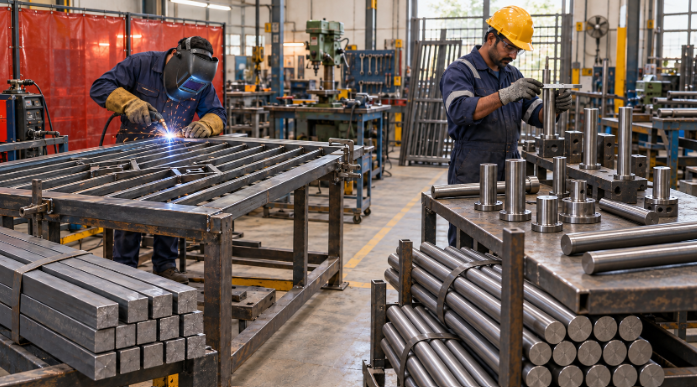
Dimensional accuracy is especially important for light structural products used in gates, grills, railings, sheds, frames, supports and general engineering work. A fabricator needs confidence that sections will fit the approved drawing and work with established cutting or assembly setups.
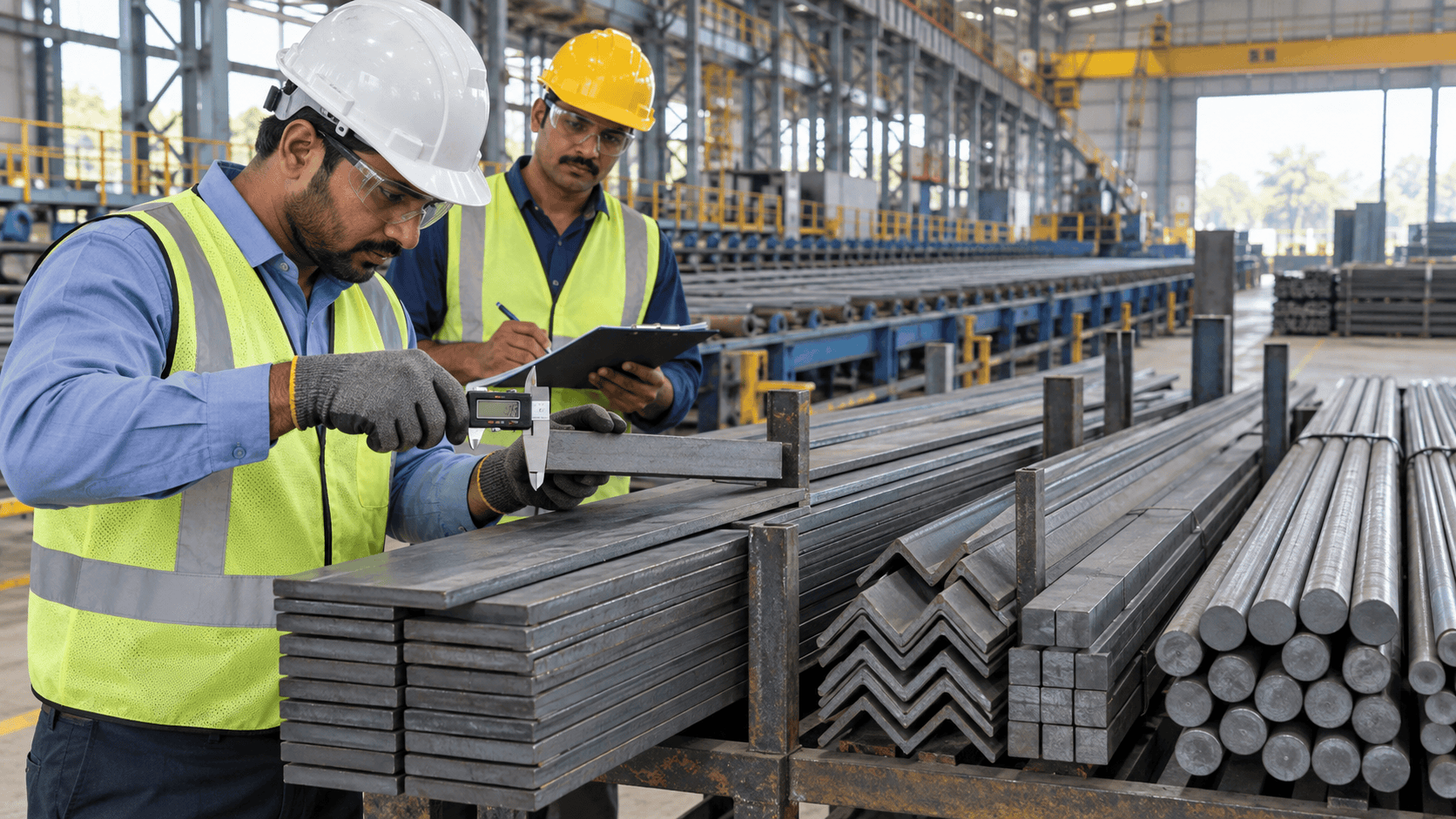
For MS flats, checks may include width and thickness. For MS angles, leg dimensions and thickness are important. Squares and rounds require verification of the relevant cross-sectional dimension. Straightness, surface condition and length may also require attention according to the product and order.
Batch Wise Inspection and Stacking
HEBE describes batch-wise quality assurance and stacking as part of its production and dispatch flow. Keeping material organized by batch supports identification and reduces the risk of mixing products during storage or loading.
Batch organization also helps the production and quality teams review material systematically. If a question arises, clear batch identification gives the team a better starting point for checking the relevant production and inspection records.
Mechanized Material Handling
Quality can be affected after production if steel is dragged, dropped or supported incorrectly. HEBE reports using EOT cranes, Hydra mobile cranes and mechanized material-handling systems in its facility.
Suitable handling equipment can help move long steel sections in a more controlled manner. It also supports orderly stacking and loading. Equipment selection, lifting methods and operator practices must follow the load, site conditions and applicable safety procedures.
Computerized Weighbridges and Dispatch Control
HEBE reports two computerized weighbridges with a capacity of 100 MT each. Weighbridge records support dispatch verification by documenting vehicle weights through the facility process.
Weight verification complements product counting, bundle identification and loading checks. It does not replace dimensional or material testing, but it provides an additional control during dispatch preparation.
Quality Across the HEBE Product Range
MS Flats
MS flats are widely used in gates, grills, railings, brackets, frames, base plates and supports. Consistent width and thickness help fabricators plan cutting and fitting more reliably.
MS Angles
MS angles are used in frameworks, brackets, sheds, supports and door or window fabrication. Consistent leg dimensions and thickness support alignment during cutting and assembly.
MS Squares
MS squares are used in grills, gates, frames, fixtures and engineering work. A consistent square profile supports repeatable spacing, fitting and joining.
MS Rounds
MS rounds are used in general engineering, hardware and fabricated components. Diameter consistency matters when a part must fit an approved hole, sleeve, fixture or machining setup.
How Customers Can Specify Quality Requirements Clearly
Buyers should provide the product, section size, quantity, required length, application and any applicable grade or standard when requesting material. Project-specific tolerances, documentation and testing needs should be communicated before order confirmation.
Clear purchase requirements allow the manufacturer and customer to confirm what will be supplied and which documents are required. A general website description should never replace the approved drawing, purchase specification or engineering requirement for a critical application.
Quality Questions Buyers Should Ask
HEBE Quality and Manufacturing Information
HEBE Steels positions its products around dimensional accuracy, uniformity, strength, durability and customer specification alignment. Its documented facility includes a rolling mill, an in-house testing laboratory, computerized weighbridges and mechanized handling equipment.
Read more about HEBE's quality approach and manufacturing facilities.
Conclusion
HEBE's approach connects manufacturing control with testing, dimensional inspection, batch organization, material handling and dispatch verification. Together, these controls support the consistency required by dealers, fabricators, contractors and industrial buyers.
For MS flats, angles, squares or rounds for fabrication, construction or general engineering work, contact HEBE Steels to confirm product availability, applicable specifications, quality documentation and dispatch support.
©2025-26, Hebe Steels Private Limited. All Rights Reserved.